-
About Jordan
About Jordan
-
Client Testimonials
Client Testimonials
-
Selling My Home
Selling My Home
-
Buying a Home
Buying a Home
-
Contact Jordan
Contact Jordan
About Jordan

Client Testimonials

Selling My Home

Buying a Home

Contact Jordan

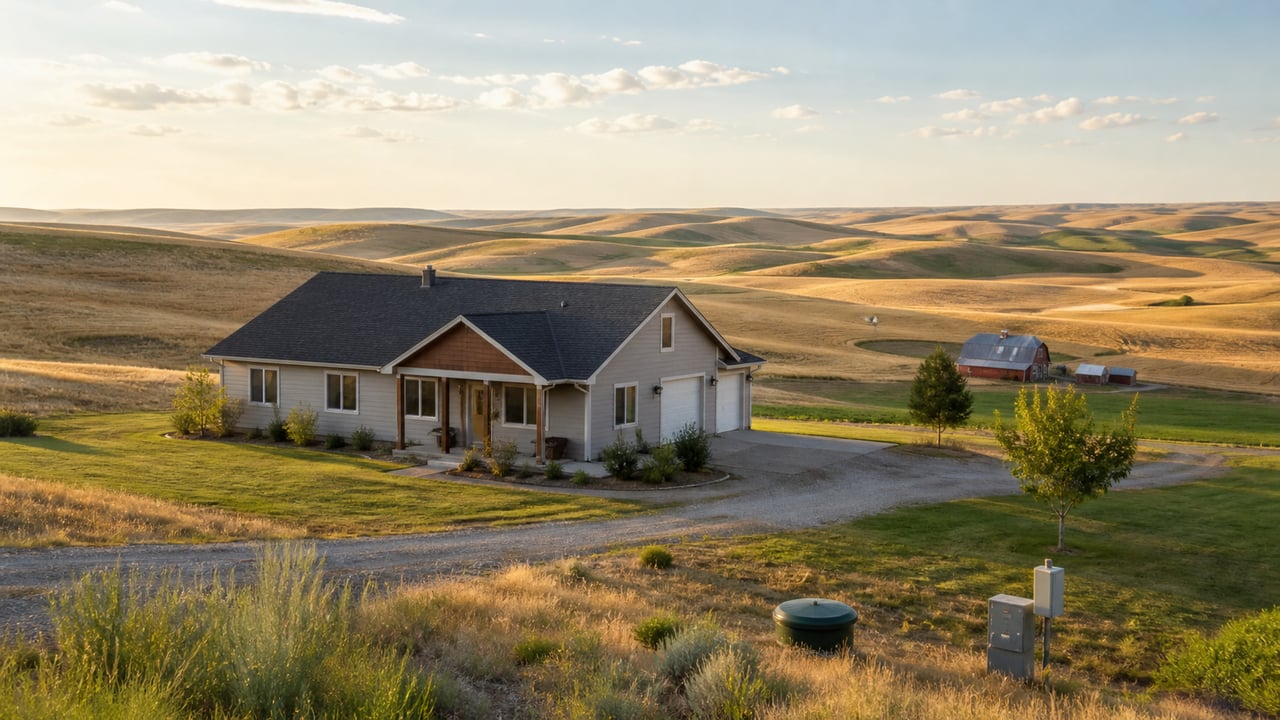
Buying rural property near Pullman or Moscow starts with one principle: you are buying the land, access, water, wastewater system, and utility setup along with the house. Before you remove contingencies, verify that the property can support your intended use, that the well and septic system have acceptable records and test results, that access is legally documented, and that your lender and insurer will accept the property. A beautiful view or useful acreage matters, but the systems serving the property determine whether it works in daily life.
By Jordan Vorderbrueggen | August 27, 2026
Rural homes across Whitman County, Latah County, and the broader Palouse can offer space, privacy, outbuildings, and flexibility that are difficult to find inside city limits. They also place more responsibility on the owner.
The goal is not to avoid every property with a private well, septic system, or shared road. It is to understand what you are taking on before your deadlines pass.
Start with the question behind the purchase. Are you buying an existing home, planning an addition, adding an accessory structure, keeping animals, operating a business, dividing land, or building later?
Then verify the answer with the planning authority that controls the parcel. A listing description, prior use, or neighboring property does not establish what you may do. Ask about zoning, setbacks, building permits, flood or critical-area review, lot-division rules, and any approvals your specific plan would require.
If future construction is a major reason for buying, make county confirmation part of your due diligence. Do not assume a large parcel automatically has a practical building site.
Determine whether the property uses an individual well, a shared or small water system, or another approved source. Request the well log when available, maintenance records, recent laboratory results, and information about pumps, storage, treatment equipment, and known interruptions.
Water quality and water quantity are different questions. A laboratory test can identify contaminants included in the test panel, while a well-flow or recovery evaluation helps show whether the system can meet the property's needs. Ask your inspector, lender, and county which tests apply to the property and loan.
Whitman County Public Health identifies nitrate and total coliform as contaminants of concern for individual wells in the county. The Washington State Department of Health recommends annual private-well testing for coliform bacteria and nitrate. In Idaho, the Department of Environmental Quality explains that private-well owners are responsible for ensuring their water is safe.
The correct test scope is property-specific. Use an accredited or certified laboratory and follow its sampling instructions.
Ask for the septic permit, design, installation records, pumping history, repair history, and the location of the tank, drainfield, and replacement area. The number of bedrooms a system was approved to serve may matter more than the number currently advertised in the home.
For Whitman County properties, county guidance provides a transfer-assessment process using licensed evaluators. Review the current requirements with Whitman County Public Health early enough to address problems before closing.
For Latah County properties, Idaho's public-health districts handle site evaluations, permit records, installation approvals, and property-specific questions. The Idaho Department of Environmental Quality explains how those responsibilities are divided.
A general home inspection is valuable, but it is not automatically a full septic evaluation. Confirm the scope in writing. The site's soil, slope, setbacks, and available replacement area can all affect repair options.
A visible driveway does not answer every access question. Confirm that the parcel has legal access and review any recorded easements, shared-driveway agreements, or private-road maintenance obligations in the title materials.
Then compare the documents with the physical route. Ask who maintains the road, how expenses are divided, whether snow removal is addressed, and whether the road can accommodate ordinary service and emergency vehicles. If access crosses another parcel, make sure the recorded rights match the route being used.
These are questions for the title company, surveyor, attorney when appropriate, and the professionals reviewing the property. Do not rely only on an informal arrangement between current neighbors.
County mapping is useful for research, but an online parcel outline is not a boundary survey. Review the legal description, title report, easements, and any available survey.
Pay attention to fences, outbuildings, driveways, wells, drainfields, utility lines, and agricultural access that appear close to a boundary. If the property's value depends on a particular area, view, access point, or future homesite, ask whether a survey or other specialist review is appropriate before closing.
Identify the provider and service arrangement for electricity, heating fuel, internet, phone coverage, water, and wastewater. Ask for recent costs when the seller is willing to provide them, but remember that usage varies by household and season.
For an unimproved parcel or planned expansion, obtain written estimates for extending power, installing or upgrading a well, designing a septic system, improving access, and connecting communications. A nearby utility line does not guarantee an inexpensive connection.
If reliable internet or cellular service is essential for work, verify it at the property. Coverage maps and a seller's experience are helpful starting points, not substitutes for testing the service you expect to use.
Rural properties can raise financing questions about acreage, property condition, water and septic documentation, access, outbuildings, manufactured homes, agricultural use, or mixed residential and business features. Send the property details to your lender before assuming a preapproval covers it.
Insurance deserves the same early review. Ask an insurer to evaluate the specific address, structures, heating systems, access, and other relevant features before your contingency deadlines. The goal is to learn whether coverage is available and what conditions or costs may apply.
Avoid making a property fit a loan program on paper. The financing and the property should work together without hiding how the property is actually used.
A rural inspection plan may include more than the general home inspection. Depending on the property, you may need qualified reviews of the well, water quality, septic system, outbuildings, foundation, roof, heating equipment, underground tanks, drainage, pests, survey matters, or environmental conditions.
Use the general Pullman home-inspection guide as a starting point, then expand the scope based on the property. Ask each professional what is included, what is excluded, and whether another specialist is needed.
The most efficient process usually begins before the offer. Share the listing or parcel number with your agent and lender, identify obvious questions, and confirm which specialists could be available within the proposed timeline.
After mutual acceptance, organize the work by decision impact:
If you are purchasing from another area, the remote buyer's guide for Pullman explains how to organize tours and local review. The same discipline matters even more when the property includes acreage or private systems.
Usually not by itself. A general inspection may not include a complete well, water-quality, septic, survey, access, or land-use review. Build the inspection plan around the specific property and confirm each professional's scope in writing.
Whitman County Public Health provides a system-assessment process using licensed evaluators. Confirm the current transfer requirements, timing, and required forms directly with the county for the property you are considering.
Latah County is served by Public Health, Idaho North Central District. The district can address property-specific site evaluations, permits, inspections, and existing septic records.
Yes. Many contaminants cannot be identified by taste, smell, or appearance. Use a qualified laboratory, confirm the appropriate test panel, and follow the sampling instructions provided by the lab and local health authority.
Possibly, but approval depends on the borrower, property, documentation, condition, intended use, and loan program. Give the full property details to your lender early and ask what inspections, tests, repairs, or records will be required.
The best rural purchase is not the one with the fewest questions. It is the one where the important questions are answered before you become committed to a property that does not fit your plans.
If you are considering acreage or a rural home near Pullman, Moscow, or elsewhere on the Palouse, send Jordan Vorderbrueggen the address or parcel number through the contact page. You can map the likely due-diligence steps before deciding how to structure an offer. You can also review current homes for sale across the area.
About Jordan Vorderbrueggen
Jordan Vorderbrueggen is a locally raised real estate agent with Woodbridge Real Estate serving Pullman, Washington; Moscow, Idaho; and communities across the Palouse. He helps buyers, sellers, relocating households, investors, and long-time homeowners make clear, informed real estate decisions.
This article provides general planning information, not legal, lending, engineering, environmental, insurance, or inspection advice. Requirements and property conditions vary. Confirm decisions with the relevant county and appropriately licensed professionals.
Browse active listings in the area or contact us for off-market listings.
Have an expert help you find out what your home is really worth.